Posts

Common Watersnake / Common Misunderstandings
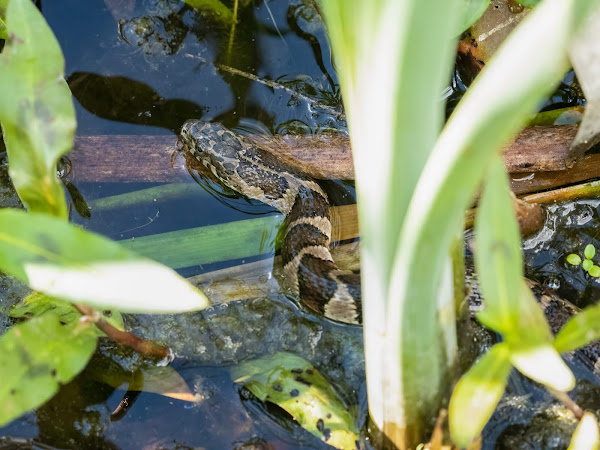
Image
Common Watersnake at the Homer Lake Wetland, May 26, 2021 As I make my way along the edge of the wetland pond, there is a familiar undulating motion in the emergent vegetation ahead of me. Then a pause. I shift my position for a better vantage point and I see a familiar pattern of beige and dark brown. I've disturbed a common watersnake  (Nerodia sipedon) in the midst of its search for breakfast. After I've had a look, it speeds off through the vegetation, often disappearing underwater not to be seen again that day. Common Misunderstanding 1 : "Any snake you see in the water must be a water moccasin (or cottonmouth -- two different names for the same snake, Agkistrodon piscivoris)."  Not true: there are numerous species of aquatic snakes (and in fact all snakes can swim when needed). In many places and certainly here in Central Illinois, the common watersnake is by far the most common snake you will see in the water in an aquatic environment. We do have wat...

Return of the Spangled Skimmer!

Image
Male Spangled Skimmer at the Homer Lake Wetland, June 14, 2021 First, I apologize to those who thought they were going to be reading about a much-anticipated sequel to a movie about a superhero in glittery tights. Spangled skimmers (Libellula cyanea) are not superheroes per se, but like all dragonflies, they are cool in their own rights. In my fifth year of documenting dragonfly diversity at the Champaign County Forest Preserves, last year on June 12th I saw  at the Homer Lake Wetland  two spangled skimmers . That was a new county record for Champaign County. Those two were the only ones I saw last year. This year on June 14th I was excited to see a half dozen male spangled skimmers hanging out at the wetland, guarding territories in hopes that the females would be stopping by. A first conclusion would be that the two I saw last year, a male and a female, met up at some point and successfully produced a new generation at the wetland. However, bear in m...

Race Against Time Reprieve!

Image
  Water is Back — same spot as the picture in yesterday’s post (facing the opposite direction) Overnight there was about 3/4 inch of rain in the Homer area and the very same path through the wetland I posted a picture of yesterday showing only deep footprints in thick mud is now again covered in water. Amazing what a good rain will do, and good news for the many tadpoles yet to transform into frogs... Also apparently good news for the toad population. After many weeks— probably a month or more of silence of the toads, American toads were calling again late this afternoon apparently quite encouraged by the additional rainfall. The gray treefrogs were also calling loudly from the trees surrounding the wetland. I haven’t heard from them in a quite a while either. I am wondering since these two species come special to the wetland just to breed and otherwise live away from it, if they are especially encouraged to sing when there is a good rain? I will try to keep my eyes open for new to...

Tadpole Progress and the Race Against Time

Image
Gray Treefrog Tadpole, Homer Lake Wetland, June 17, 2021 Let me just get this out of the way and say, "Wow! I don't recall ever coming across such beautiful tadpoles before!" This is an eastern gray treefrog tadpole (Hyla versicolor). The only way to know that it's an eastern gray tree frog and not a Cope's gray treefrog is by the calls that the frogs make (or by chromosomal differences, which I'm not equipped to look at!)  I've only ever heard the eastern gray treefrogs at the wetland.  This guy, and others I saw yesterday were similarly sized, was about 38mm (about an inch and a half) in length. That's not bad considering that the first I heard gray treefrogs calling near the wetland this year was April 9th, and those were from the trees surrounding the wetland. The first I noted hearing the eastern gray treefrogs calling from the water's edge was on April 30th.  Gray treefrog eggs are said to be from 4mm to 8mm in diameter, so 38mm in leng...

Gradual Changes and Decisive Moments (video)

Image
  Walking through the wetland Tuesday morning (6/15) a little before 8am I was surprised to find three meadowhawks still early in the process of emerging as dragonflies (the process is known as "eclosion" or "eclosure") since normally this seems to take place in earlier morning hours.  I grabbed my tripod and began capturing some of the process. The first emerging dragonfly I began videoing sadly met an unfortunate end. After about an hour of videoing I saw that it was making no progress and turned my camera on the dragonfly above. Later in reviewing the video of the first dragonfly, the one that failed to emerge, I saw that it started well but then was attacked by ants which apparently effectively neutralized it and it died in process! The video above has a happier ending. It is a 29 second video showing a series of 5 second excerpts taken over the course of a little more than two and half hours. This captures the gradual development of its coloration as the exosk...

Left Hangin'

Image
Shed Exoskeleton of a Six-Spotted Fishing Spider Dangling in the Breeze, June 15, 2021 You may recall the six-spotted fishing spider  (and to any who were trying to forget, my apologies). Spiders, like other arachnids and like crustaceans and insects, have exoskeletons which support and protect their bodies and to which their muscles attach. Once an exoskeleton has hardened, however, it does not allow for growth, so all of these creatures (in addition to reptiles who run into the same limitations with scales) have to shed their exoskeletons periodically in order to grow larger. Because the process of shedding and then the period of time while the new exoskeleton is hardening leaves them quite vulnerable, I'm guessing that the fishing spiders do this at night. When I walk through the wetland in the early morning hours, I often see these shed spider exoskeletons attached to wetland plants. Spiders, of course, have the luxury of attaching themselves to the plants with t...

The Fascinating (but slightly horrific) Water Mite

Image
Adult Water Mite, Homer Lake Wetland April 22, 2021 Although the title says "the water mite," there are actually something like 5000 species of water mites (out of at least 48,000 species of mites worldwide). It may be comforting to know though that only about 1500 of the aquatic species live in North America. Or perhaps not. In the photo above you can see a water mite on the underside of the leaf toward the top right. If you think it looks like a spider, you're right. Mites, like ticks by the way, are arachnids as are spiders. The most notable similarities are the two-part bodies (as opposed to three parts in insects) and eight legs (as opposed to six in insects, though apparently while in their larval stage, mites also have six... just to keep things interesting). Mites survive the drying of the wetland and winter in the egg stage of life. When the wetland is wet again, the eggs hatch and they undergo multiple life stages... and livelihoods. In one of those life stages,...