Posts

The Migratory Common Green Darner: An Ephemeral Wetland Winner!

Image
Most of the 380 Common Green Darner Exuviae Collected at the Homer Lake Wetland, July 2 to September 11, 2021 How do you spell success? Certainly in the natural world, one good measure of success is successfully producing the next generation. Breeding in an ephemeral wetland, which is almost certainly going to dry up towards the end of the summer, is a strategy with both risks and rewards. For many of the species that breed here, one of the greatest rewards is the absence of fish. The risk though, as we've been seeing, is that if your young are dependent on the aquatic environment and the wetland dries up before they've matured, you've lost the bet. This is the sad reality for hundreds and hundreds of green frog and bullfrog tadpoles, for example. For the migratory common green darner, however, it is a different story -- the gamble appears to have largely paid off. In order to better understand how successful these dragonflies were in producing the next generation in the ...

What Would I be if I were One of These?

Image
Aquatic Fly Larva, Homer Lake Wetland, October 8, 2021 Or maybe better, "What would I become if I were one of these?" This is one of many kinds of aquatic fly larvae. Yeah, I know. Aquatic fly larvae? Are you kidding? Nope. According to this journal article , using a broad definition of aquatic species, some 46,000 fly species have some connection to aquatic habitats at some point in their development (I know -- you're thinking, 46,000 fly species!? And that's only about 1/3 of the known fly species...).  This particular larva seems to be of the soldier fly family. Descriptions of some of the soldier fly species match up with some of the small shiny green flies I saw hanging around on plant leaves on the surface of the water much earlier in the season, so I suspect that this is one of their offspring. The upraised "tail" functions as a snorkel as this is an air-breathing aquatic creature. In addition to the soldier fly family, many other fly families have me...

Two Orange and Black Beetles for October

Image
Predaceous Diving Beetle from the Homer Lake Wetland, October 8, 2021 Among the creatures that reappeared when the water came back to the wetland at the end of last week were the predaceous diving beetle above and the crawling water beetle below, both suitably attired in orange in black in honor no doubt of October. Lest there be any misunderstanding, let me clarify that these are small (half a centimeter or less) and that the names "predaceous diving beetle" and "crawling water beetle" are broad family names, not specific to these individual species.  The predaceous diving beetle family consists of more than 4000 species, of which some 600 can be found in North America ( https://www.sciencedirect.com/topics/agricultural-and-biological-sciences/dytiscidae ) .   The crawling water beetle family has a much more modest 238 species ( https://www.sciencedirect.com/topics/agricultural-and-biological-sciences/haliplidae ).  Crawling Water Beetle from the Homer Lak...

Water Mite Revisited

Image
Water Mite at the Homer Lake Wetland, October 8, 2021 Among the creatures I found in the reconstituted wetland yesterday were a couple of water mites. I've written about them previously and will let you look back at the blog post " The Fascinating (but slightly horrific) Water Mite " from June 14 of this year if you want to know more about them, but because they are only a couple of millimeters long, this is the best photo I've gotten of one so far and wanted to share it.  Here you can see four legs on its right side (and there are four on the left as well), reminding us that mites are arachnids like spiders and ticks, not insects, which have only six legs.

Again With the Water! (and the frog calls!)

Image
  Homer Lake Wetland, October 8, 2021, after approx. 1.33" of rain this past week The photo above shows the wetland today. Reviewing my weather app it looks like there has been a little over 1.3" of rain since it was nothing but mud twelve days ago September 26 (photo below), and cracked earth on September 29. I think the hardening of the dry ground contributes to the water running off of the adjacent areas and refilling the wetland rather than soaking in where it fell. As I walked through the wetland today the ground under the water was still hard and I sunk only slightly into mud once or twice. Today's amount of water in the wetland is the most I've seen since early September. Homer Lake Wetland, September 26, 2021 So what happens when the wetland is wet again after twelve days of dry? First off, as the grasses expanded to fill in where the water levels were shrinking, along with them come caterpillars, which now find themselves underwater or floating on the t...

Unusual Behavior? Common Green Darners Ovipositing in Mud

Image
Pair of Common Green Darners Laying Eggs in Mud, September 15, 2021 Nerd Alert: this post is about observing an unexpected, I believe, dragonfly behavior. I find it interesting -- your mileage may vary. Female common green darners normally lay their eggs in plant stems or floating vegetation below the water's surface. However, multiple times in past years I have observed tandem pairs (the male guarding the female by holding her by the back of her head and flying together to suitable egg-laying locations) laying eggs in dry plant stems or in the dirt or mud where there is no water. I do not know and have not been able to find research into whether or not common green darner eggs laid in this way end up successfully hatching and surviving to adulthood, so I had proposed a research project investigating this question. This year, however, there was standing water in the wetland almost a full month after it was completely gone last year, and once the water was gone in late September, it...

Nothing Says Fall Like a Blue-Faced Meadowhawk

Image
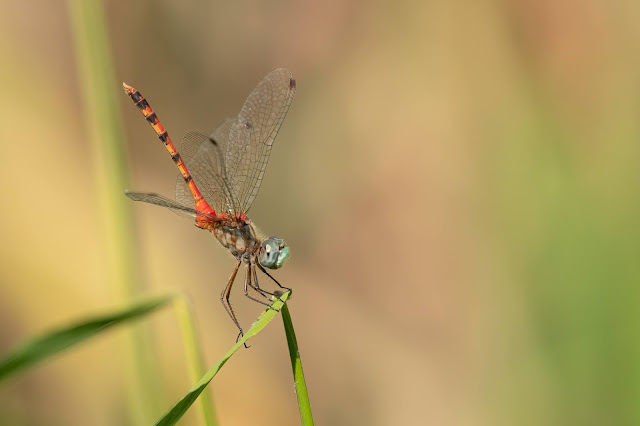
  Blue-Faced Meadowhawk at the Homer Lake Wetland, September 29, 2021 If you take a walk in the area where the wetland water used to be, you'll see dozens of these guys perched in the vegetation or chasing each other around. These are male blue-faced meadowhawks and they're defending good positions for when the females show up. There is no longer any standing water in the wetland, but several meadowhawk species have the strategy of dropping their eggs in areas they expect there to be water come late Fall or early Spring. In addition to ephemeral pools of water being fishless, already a great advantage for the many species that prefer ephemerals, I think the meadowhawk strategy of dropping eggs in the fall where there is no water may also give them a competitive advantage over other dragonfly species. Meadowhawk species are smallish dragonflies, so jumpstarting the growth of their naiads as soon as there is water in the wetland again and before other dragonflies are around...