Posts

Wonders of the Wetland: Thirty-Two Photos in Celebration of the Homer Lake Wetland

Image
The thirty-two photos above are now on display at the Homer Lake Interpretive Center during their regular hours through the beginning of April 2023. Come take a look at a few of the things I think capture some of the Wonders of the Wetland!   If you can't make it out to Homer Lake, the websites below complement each of the topics in the exhibit and include the exhibit photos along with brief explanations, a few additional photos, related video and some links for those who want still more. Exhibit Links — check it out from home if you can't make it in or expand on your visit if you want to know more! Wonders of the Wetland: If You Build It They Will Come Dragonflies: a Closer Look Other Creatures Underwater They Call It Home: Frogs at the Homer Lake Wetland Personal Statement
Images of Fall and Farewell!

Image
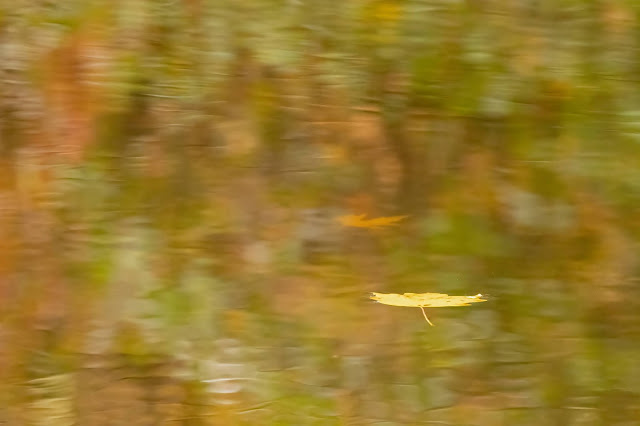
Here are five images of the wetland captured today (11/11/21). The Fall beauty of the wetland speaks for itself.  I hope you enjoy the Fall Photos! Most of the plants and animals are transitioning to a season of rest, and I am as well. Between March 1 and September 30th this year I spent over 200 hours at the wetland and many more hours working on my photos, videos and blog posts. I've enjoyed just about every minute of it and have learned a lot, but it's time for a change. My hope is that this blog has incited curiosity and stirred up wonder for all who've read some of the posts. And of course the blog will remain as a resource for all who are interested in exploring more of the wonders of the wetland. Spoiler Alert: I've been in discussion with the folks at the Homer Lake Interpretive Center and the current plan is for me to collaborate with them on an interpretive display about the wetland coming probably in April 2023 to be displayed in the Interpretive Cen...

If You Build It...

Image
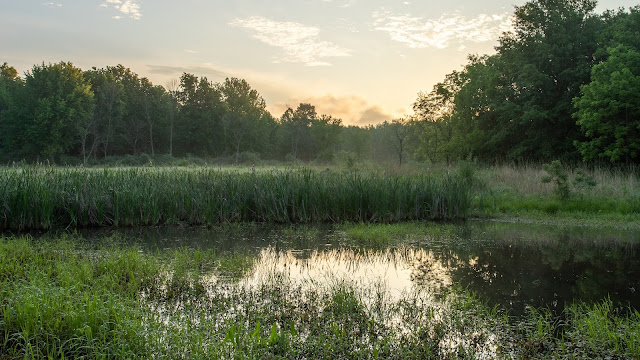
The Wonderful Wetland, June 8, 2021 shortly after sunrise It may surprise you to know that fifteen years ago this wonderful, magical, glorious wetland, which I've spent the last eight months marveling at and blogging about, did not exist except on paper. The Homer Lake Wetland I am so fascinated with is a wetland restoration proposed by the Champaign County Forest Preserves and partially funded by a Five Star Restoration Challenge Grant awarded by the National Association of Counties in July, 2006.  The photo below shows the site of the proposed wetland in September 2006 before any work had begun. You may recognize the tree at the right in the photo below as the now dead snag standing on the east edge of the wetland visible in many of the photos of the wetland I have posted, a favorite perch for bluebirds and flycatchers watching for flying insects emerging from or attracted to the wetland. Likewise, bluebird nesting box number seven at the bottom left of the photo below still...

Refilled!

Image
The Wetland Again Full, October 27, 2021 After over two inches of rain this week, the water level at the wetland is as high as it gets in spring and early summer. For the sake of comparison, below is a photo from one year ago tomorrow, October 28, 2020. In addition to the total absence of water a year ago -- the wetland was dry before the end of August last year and to the best of my knowledge stayed dry until the end of November -- notice the difference in how much the trees had turned a year ago vs. this year at this time. Also notice how tall the dry-land plants had grown last year where the water had been since they had so much longer to grow at the end of summer. It will be interesting to see how much the almost continuous water in the wetland this year impacts things like whether or not dragonfly species  that did not survive the dry spell last year  successfully emerge next year, and if so, which ones. So far I have been able to identify only one species of dr...

Boatman and Backswimmer: Two More TRUE Bugs

Image
Water Boatman, Homer Lake Wetland, October 16, 2021 Checking  out the wetland last week (October 16) to see what was still lurking in "the depths" (ok, about a foot deep in the deepest section at that point) I pulled out two more true bugs we've not yet looked at in this blog. They have a lot in common but also some important differences. In common, both water boatmen and backswimmers are true bugs. As noted before, all true bugs (insect order hemiptera), such as the water scorpions and giant water bugs which we've already seen, have piercing mouthparts which they use to suck up their meals. In addition, like most of the aquatic insects and arachnids we've seen, water boatmen and backswimmers carry air bubbles around with them underwater like little scuba tanks. Also in common, both water boatmen and backswimmers have elongated back legs fringed with fine hairs that they use like oars to make their way through the water -- surprisingly fast, actually. Two impo...

Another October Orange and Black Beetle (and a note on the bubble behind)

Image
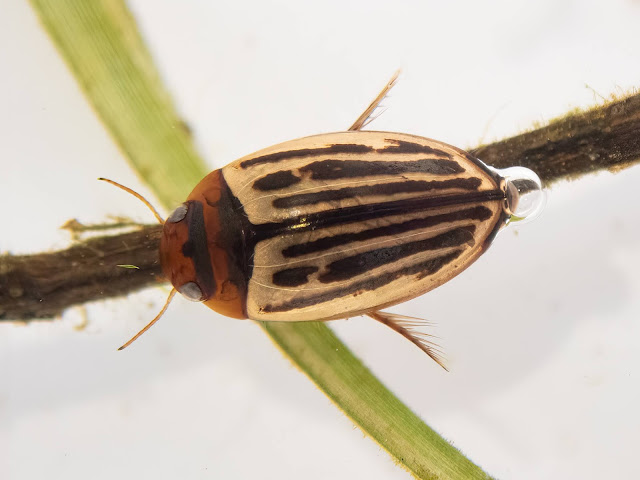
Disintegrated Diving Beetle with Breathing Bubble, Homer Lake Wetland, October 16, 2021 Another predaceous diving beetle  suitably colored orange and black  for the month of October! Like one of the two beetles featured in t he orange and black post last week , this is another one of the 600 species of predaceous diving beetles found in North America. It was a bit larger than the two featured last week, but only by a couple of millimeters, being perhaps six or seven millimeters long (still less than half an inch). Notable in the photo above is the bubble on its behind. Like the other beetles last week (and the giant water scavenger beetle I wrote about half a year ago in April and many, but not all, of the other aquatic insects we've seen), these beetles breathe air and carry their air supply with them when they go underwater. Their bodies are uniquely adapted for this purpose. It may seem a bit awkward to drag an air bubble around on your behind, but this actually serve...

Return of the Snapper!

Image
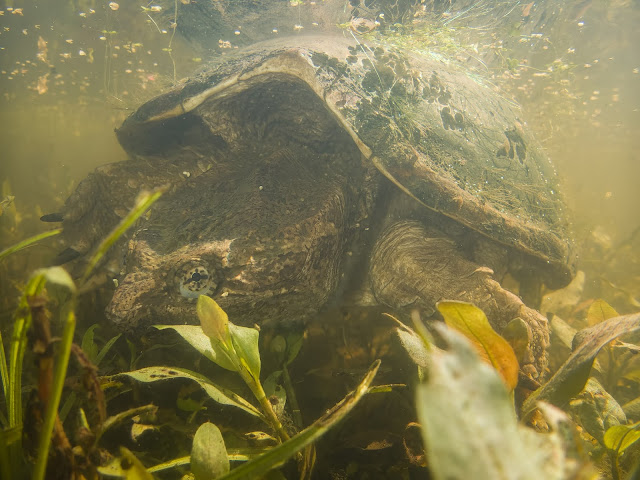
Snapping Turtle (back) at the Wetland, October 16, 2021 The rain has continued much of the past week -- five of the eight days between my visit on Friday 10/8 and my next visit on Saturday 10/16 for a total rainfall in the Homer area of 1.86 inches (according to my Dark Sky app). The water level on the 8th was already impressive for this time of the year, so needless to say, doubly impressive when I visited yesterday. Perhaps the most elegant testimony to this fact was the return of the snapper. If you've followed this blog you may recall that I first saw the snapping turtle on the lawn near the wetland on July 31, then in the wetland on August 4th and again on August 14th . That was the last I saw of her* up until yesterday. Meanwhile, the wetland has been completely dry. Twice. So imagine my astonishment and wonder when I arrived at the wetland yesterday and one of the first things I saw was her large shell protruding from the water near the shore.  The air temperature...

The Migratory Common Green Darner: An Ephemeral Wetland Winner!

Image
Most of the 380 Common Green Darner Exuviae Collected at the Homer Lake Wetland, July 2 to September 11, 2021 How do you spell success? Certainly in the natural world, one good measure of success is successfully producing the next generation. Breeding in an ephemeral wetland, which is almost certainly going to dry up towards the end of the summer, is a strategy with both risks and rewards. For many of the species that breed here, one of the greatest rewards is the absence of fish. The risk though, as we've been seeing, is that if your young are dependent on the aquatic environment and the wetland dries up before they've matured, you've lost the bet. This is the sad reality for hundreds and hundreds of green frog and bullfrog tadpoles, for example. For the migratory common green darner, however, it is a different story -- the gamble appears to have largely paid off. In order to better understand how successful these dragonflies were in producing the next generation in the ...

What Would I be if I were One of These?

Image
Aquatic Fly Larva, Homer Lake Wetland, October 8, 2021 Or maybe better, "What would I become if I were one of these?" This is one of many kinds of aquatic fly larvae. Yeah, I know. Aquatic fly larvae? Are you kidding? Nope. According to this journal article , using a broad definition of aquatic species, some 46,000 fly species have some connection to aquatic habitats at some point in their development (I know -- you're thinking, 46,000 fly species!? And that's only about 1/3 of the known fly species...).  This particular larva seems to be of the soldier fly family. Descriptions of some of the soldier fly species match up with some of the small shiny green flies I saw hanging around on plant leaves on the surface of the water much earlier in the season, so I suspect that this is one of their offspring. The upraised "tail" functions as a snorkel as this is an air-breathing aquatic creature. In addition to the soldier fly family, many other fly families have me...

Two Orange and Black Beetles for October

Image
Predaceous Diving Beetle from the Homer Lake Wetland, October 8, 2021 Among the creatures that reappeared when the water came back to the wetland at the end of last week were the predaceous diving beetle above and the crawling water beetle below, both suitably attired in orange in black in honor no doubt of October. Lest there be any misunderstanding, let me clarify that these are small (half a centimeter or less) and that the names "predaceous diving beetle" and "crawling water beetle" are broad family names, not specific to these individual species.  The predaceous diving beetle family consists of more than 4000 species, of which some 600 can be found in North America ( https://www.sciencedirect.com/topics/agricultural-and-biological-sciences/dytiscidae ) .   The crawling water beetle family has a much more modest 238 species ( https://www.sciencedirect.com/topics/agricultural-and-biological-sciences/haliplidae ).  Crawling Water Beetle from the Homer Lak...

Water Mite Revisited

Image
Water Mite at the Homer Lake Wetland, October 8, 2021 Among the creatures I found in the reconstituted wetland yesterday were a couple of water mites. I've written about them previously and will let you look back at the blog post " The Fascinating (but slightly horrific) Water Mite " from June 14 of this year if you want to know more about them, but because they are only a couple of millimeters long, this is the best photo I've gotten of one so far and wanted to share it.  Here you can see four legs on its right side (and there are four on the left as well), reminding us that mites are arachnids like spiders and ticks, not insects, which have only six legs.

Again With the Water! (and the frog calls!)

Image
  Homer Lake Wetland, October 8, 2021, after approx. 1.33" of rain this past week The photo above shows the wetland today. Reviewing my weather app it looks like there has been a little over 1.3" of rain since it was nothing but mud twelve days ago September 26 (photo below), and cracked earth on September 29. I think the hardening of the dry ground contributes to the water running off of the adjacent areas and refilling the wetland rather than soaking in where it fell. As I walked through the wetland today the ground under the water was still hard and I sunk only slightly into mud once or twice. Today's amount of water in the wetland is the most I've seen since early September. Homer Lake Wetland, September 26, 2021 So what happens when the wetland is wet again after twelve days of dry? First off, as the grasses expanded to fill in where the water levels were shrinking, along with them come caterpillars, which now find themselves underwater or floating on the t...

Unusual Behavior? Common Green Darners Ovipositing in Mud

Image
Pair of Common Green Darners Laying Eggs in Mud, September 15, 2021 Nerd Alert: this post is about observing an unexpected, I believe, dragonfly behavior. I find it interesting -- your mileage may vary. Female common green darners normally lay their eggs in plant stems or floating vegetation below the water's surface. However, multiple times in past years I have observed tandem pairs (the male guarding the female by holding her by the back of her head and flying together to suitable egg-laying locations) laying eggs in dry plant stems or in the dirt or mud where there is no water. I do not know and have not been able to find research into whether or not common green darner eggs laid in this way end up successfully hatching and surviving to adulthood, so I had proposed a research project investigating this question. This year, however, there was standing water in the wetland almost a full month after it was completely gone last year, and once the water was gone in late September, it...

Nothing Says Fall Like a Blue-Faced Meadowhawk

Image
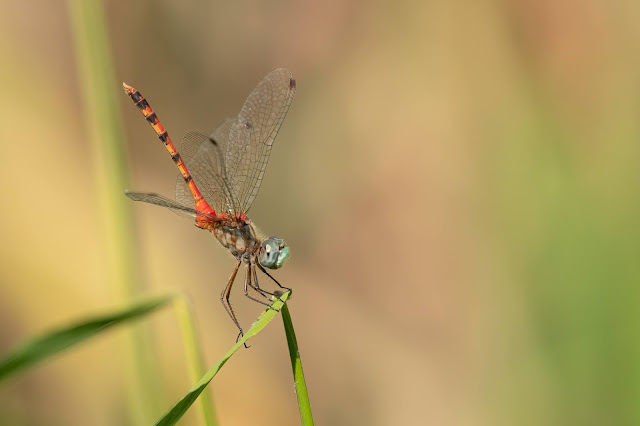
  Blue-Faced Meadowhawk at the Homer Lake Wetland, September 29, 2021 If you take a walk in the area where the wetland water used to be, you'll see dozens of these guys perched in the vegetation or chasing each other around. These are male blue-faced meadowhawks and they're defending good positions for when the females show up. There is no longer any standing water in the wetland, but several meadowhawk species have the strategy of dropping their eggs in areas they expect there to be water come late Fall or early Spring. In addition to ephemeral pools of water being fishless, already a great advantage for the many species that prefer ephemerals, I think the meadowhawk strategy of dropping eggs in the fall where there is no water may also give them a competitive advantage over other dragonfly species. Meadowhawk species are smallish dragonflies, so jumpstarting the growth of their naiads as soon as there is water in the wetland again and before other dragonflies are around...

Here Today, Gone Tomorrow

Image
Common Whitetail Dragonfly Naiad, Homer Lake Wetland, September 25, 2021 When I visited the wetland on Saturday, in addition to a photoshoot with a water scorpion , I was looking at what else was still moving around in the water. Mostly at this point it was dragonfly naiads. A couple of scoops with a metal strainer into the shallow water and mud produced about a dozen of them. Most of them, like the one above, were nearing the stage where they would emerge from the water and emerge from their old exoskeletons as adult dragonflies, but not quite yet... When I came back on Sunday afternoon for a brief visit, there was no more standing water. While it's again possible some of the dragonfly naiads will have escaped into the mud and will survive a while, many of them, like the one pictured below, did not. And those that made it into the mud are not likely to survive the winter to emerge next year. These species normally overwinter in the water and are not adapted for surviving the dryin...

Water Scorpion! (video)

Image
Water Scorpion, Homer Lake Wetland, September 25, 2021 The standing water at the wetland was about half today of what it was yesterday when I arrived this morning. Many of the creatures I saw in the water yesterday were no longer to be seen today. I did not see, for example, any giant water bug nymphs or any common green darner dragonfly naiads, though today I saw dragonfly naiads I did not see many of yesterday or the day before. However, one of the things I had hoped to accomplish today was to get a better look at a water scorpion, so I was blessed to find this guy hanging around in the little bit of water that remained. I mentioned water scorpions in passing in the previous blog post, but here's a better look. If you're thinking underwater preying mantis with snorkel at the back end for breathing air underwater, you're on the right track. You can see the resemblance in the front legs and they serve the same purpose -- raptorial legs for snagging prey. The water scorpio...

Survivors?!

Image
with 1.5" of rain over two days, the wetland bounces back... briefly, September 23, 2021 I stopped by the wetland today and discovered that after 1.5" of rain over the past two days, the aquatic phase of the wetland is back in business. I don't expect it to last long, but after everything was dry on Monday, I thought the aquatic phase of the wetland cycle was over for the summer and most of the Fall. Surprise! On Monday as I noted in that day's blog post, " Death... and Life ," there were no living aquatic creatures visible. There were plenty of frogs still hopping around, but thousands of dead tadpoles and hundreds of dead dragonfly naiads. Not surprisingly there were no signs of tadpole life today; however, there were many dragonfly naiads exploring the edges of the big puddle or scooting through it. Like the tadpoles, dragonfly naiads are completely aquatic and breathe through gills. With so many of them dead on Monday, these must have burrowed down deepl...

While There Was Water: Dragonfly Naiad Challenge

Image
video shot at the edge of the wetland, September 16, 2021, a few days before it was completely dry During the last week the wetland still had water, I shot a number of videos. I was thinking of releasing a compilation of footage trying to tell the story of the last week, and may still do that, but as I was reviewing what I had shot, I was impressed with how well adapted dragonfly naiads are at hiding in plain sight. In the one-minute video clip above, there are numerous dragonfly naiads that are very difficult to spot before they start moving. See how many you can see. (You may want to watch it more than once.)

Death... and Life

Image
The Wetland, September 20, 2021 Thursday (9/16) when I was at the wetland, what water there was was full of life (video yet to come). Today, despite rains in the past 24 hours, the water has been replaced by the stench of death. When I took the photo above, just after arriving at the wetland today, I imagined that the dark circle and darker area inside the circle at the center of the photo were places that were not as dry as the lighter-colored areas.  I was wrong. As I got closer, I realized that the dark areas are where all the dead tadpoles are, thousands of them. A Closer Look at "The Dark Circle" (click to view larger) And Closer Still (click to view larger) In addition to the dead tadpoles, a careful look reveals snails and dead dragonfly naiads as well.I It's a miniature Central Illinois version of the LaBrea Tarpits. But the title of this post mentions "life." In the top photo above, the vibrant green through the middle of the picture was mud flats a wee...